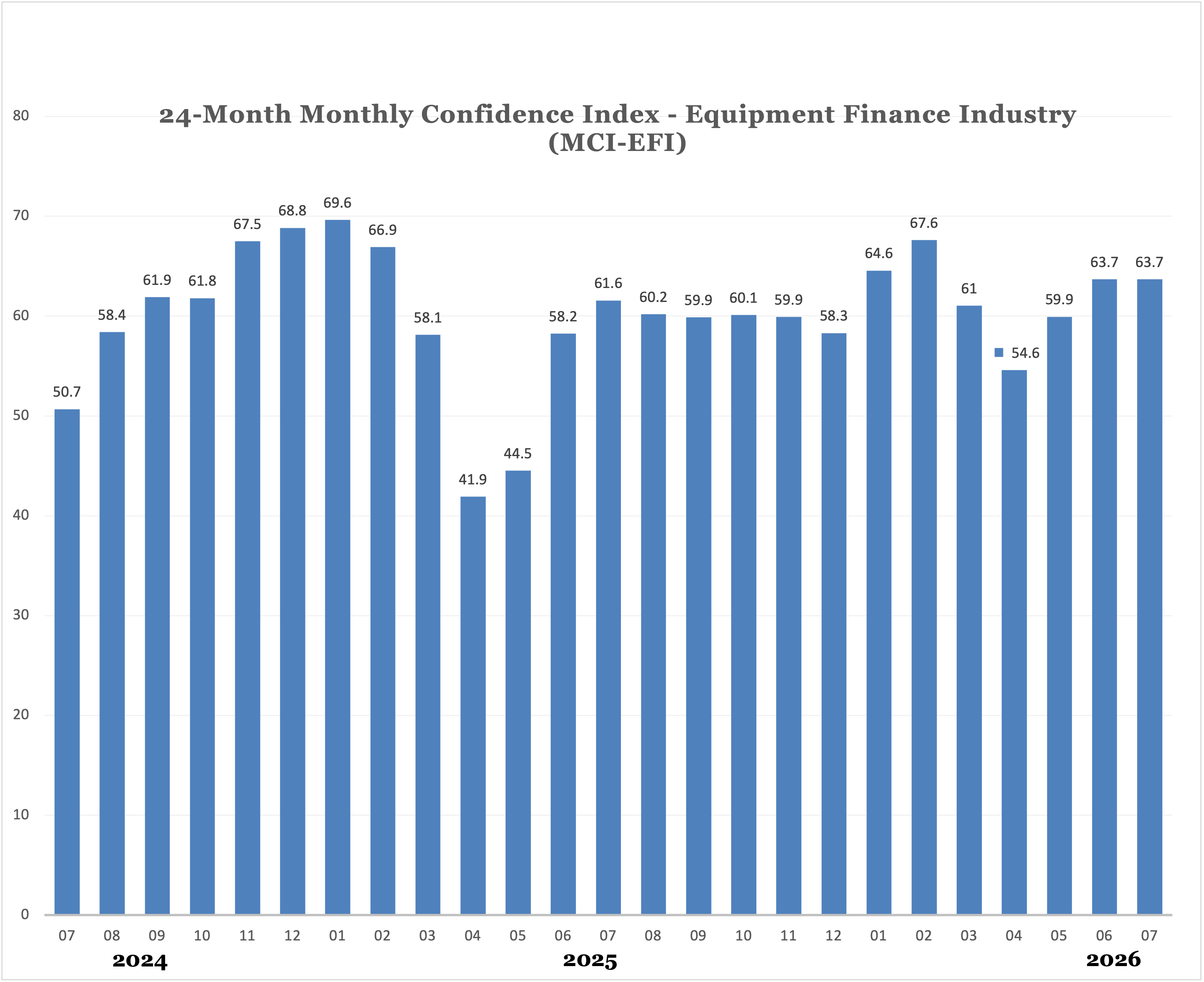

Monthly Confidence Index: July 2026
Washington, DC, July 16, 2026 – The Equipment Leasing & Finance Association (ELFA) today released its July 2026 Monthly Confidence Index for the Equipment Finance Industry (MCI), revealing confidence in the equipment finance market is 63.7, unchanged from the June index. The index provides a qualitative assessment from key executives in the $1.3 trillion equipment finance industry.
July 2026 Survey Results:
- Business Conditions – When assessing the next four months, 22.7% of responding executives believe business conditions will improve, down from 30.4% in June. Those who believe business conditions will remain the same increased to 72.7% from 65.5% the previous month. The percentage of executives who believe business conditions will worsen was relatively unchanged at 4.6%.
- Capex Demand – For the next four months, 28.6% of the survey respondents believe demand for leases and loans to fund capital expenditures (capex) will increase (down from 31.8% in June). Additionally, 66.7% expect demand to remain the same (up from 59.1% last month), and 4.6% believe demand will decline (down from 9.1% in June).
- Access to Capital – Over the next four months, 33.3% of respondents expect greater access to capital to fund equipment acquisitions, an increase from 27.3% in June. The majority (66.7%) anticipate the “same” access to capital to fund business, a decrease from 72.7% the previous month. None expect “less” access to capital, unchanged from June.
- Employment – Regarding employment over the next four months, 54.6% of executives expect to hire more employees, an increase from 50% in June. Also, 36.4% foresee no change in headcount (down from 50% last month), and 9.1% expect to hire fewer employees, up from none in June.
- U.S. Economy – Of the respondents, 15% evaluate the current U.S. economy as “excellent,” up from 8.3% in June; 80% assess it as “fair,” down from 87.5% last month; and 5% evaluate it as “poor,” up slightly from 4.2% in June.
- Economic Outlook – Over the next six months, 22.7% of respondents believe that U.S. economic conditions will “get better,” a decrease from 25% in June. Another 63.6% expect the U.S. economy to “stay the same,” up from 50% last month; and 13.6% believe economic conditions will worsen, a decrease from 25% in June.
Business Development Spending – Over the next six months, 40.9% of respondents believe their company will increase spending on business development activities, a decrease from 45.8% in June. Those who believe there will be “no change” in business development spending increased to 59.1% (from 54.2% in June), and none believe there will be a decrease in spending, unchanged from last month.
July 2026 MCI-EFI Survey Comments from Industry Executive Leadership:
With the current geopolitical events, it is very difficult to have sustained confidence in the near future of equipment finance or, more broadly, the U.S. economy in general. This is a ride that most want off of already. Just when it looks like there may be a resolution, things change and we are all waiting for the other shoe to drop.
“I remain optimistic about the near-term outlook for the U.S. economy, supported by the continued strength of the labor market and resilient consumer spending. Low unemployment and steady job creation have helped sustain household confidence, while consumers continue to demonstrate a willingness to spend, providing an important foundation for economic growth. Although interest rates and inflation continue to be closely monitored, the underlying fundamentals of the domestic economy remain encouraging. That said, I recognize that international developments—including geopolitical tensions, global trade dynamics, and supply chain disruptions—have the potential to influence economic conditions and market sentiment. While these external factors warrant careful attention, I believe the strength of the U.S. consumer and labor market positions the economy well to navigate potential headwinds.”
I’m optimistic about where the industry is headed for a number of reasons. We’re in the midst of one of the strongest capital expenditure cycles we’ve seen in years, creating sustained demand across the markets we serve. At the same time, institutional investors and private credit providers continue to recognize the value of short-duration, cash-flowing equipment finance assets, bringing additional capital into the market as banks become more selective. Perhaps the biggest catalyst is technology. AI is leveling the playing field, giving independent finance companies the same capabilities that were once reserved for the largest financial institutions. It’s helping us make faster, more informed credit decisions, streamline documentation, improve pricing, and strengthen fraud detection. That said, the same technology is making fraud more sophisticated, and abundant capital can tempt some lenders to sacrifice pricing discipline in pursuit of volume.
[I’m] not that optimistic. Various state regulations have strained creativity and choked off the ability to operate efficiently and effectively.
While the consumer may be under some pressure, business capex seems to be fairly resilient to economic and geopolitical headwinds. We're seeing steady activity across the market.
Survey Demographics
Market Segment
- Bank 45%
- Captive 5%
- Independent 50%
- Other 0%
Market Segments Based on Transaction Size of New Business Volume
- Large-Ticket (New Business Volume Avg. Transaction Size Over $5 Million) 14.3%
- Middle-Ticket (New Business Volume Avg. Transaction Size of $250,000 – $5 Million) 42.9%
- Small-Ticket (New Business Volume Avg. Transaction Size of $25,000 – $249,999) 42.9%
- Micro-Ticket (New Business Volume Avg. Transaction Less Than $25,000) 0%
Organization Size
- Under $50 Million 4.8%
- $50 Million – $250 Million 23.8%
- $250 Million – $1 Billion 23.8%
- Over $1 Billion 47.6%