
ELFA CapEx Finance Index: July 2026
August 25, 2026, 8:00 am ET
The latest CapEx Finance Index (CFI), released today by the Equipment Leasing & Finance Association (ELFA), shows that demand surged in July due to AI-related investment. Seasonally adjusted new deal volumes were $14.3 billion, standing $2.8 billion, or 24.5% above their previous all-time monthly high. The full-year forecast for annual new volume in 2026 is $137.3 billion, which would surpass its previous all-time high set in 2024 by 14.0%. Financial conditions improved, with the average loss rate falling to its lowest level in nine months. With the Fed’s next move now more likely to be a hike than a cut, and long-term yields showing little sign of retreating, the risks facing the industry in the second half lie in the cost of funds rather than demand.
- Total new business volume (NBV) among surveyed ELFA member companies was $14.3 billion on a seasonally adjusted basis.
- Year-to-date NBV rose 16.8% relative to the same period in 2025.
- Year-over-year NBV rose by 47.3% on a non-seasonally adjusted basis.

Equipment demand surged to new heights in July, on the back of AI-related investment,” said Leigh Lytle, President and CEO at ELFA. “This is the second time this year that the pace of monthly new volumes has set a new record. Credit quality improved as well, with the average loss rate at a nine-month low and delinquencies holding near the low end of their two-year range. With unrelenting demand and healthy financial conditions, it’s going to take a lot more than recent market volatility or a few Fed rate hikes to keep the industry from breaking records in 2026.
Demand exploded due to AI-related investment
Total NBV was $14.3 billion in July, a jump of 34.3% from the previous month. The total new volume series tracks the amount of new activity added by banks, independents, and captives in a given month. The full-year 2026 outlook jumped to over $137 billion, the strongest annual forecast ever recorded, and nearly $17 billion, or 14%, above the 2024 record.
Small ticket volume growth tracks broader economic conditions and is an important barometer of aggregate demand for equipment. Small ticket deals totaled $6.4 billion, up 84.5%, the highest single month ever recorded. Year-to-date, small ticket deal activity was up 25.9% from the same period in 2025.
Activity at banks was $5.4 billion, down 1.3% from June but still the third-highest month of the year. New deals at independents rose 5.0%, their strongest month since February. Activity at captives surged 94.1%.
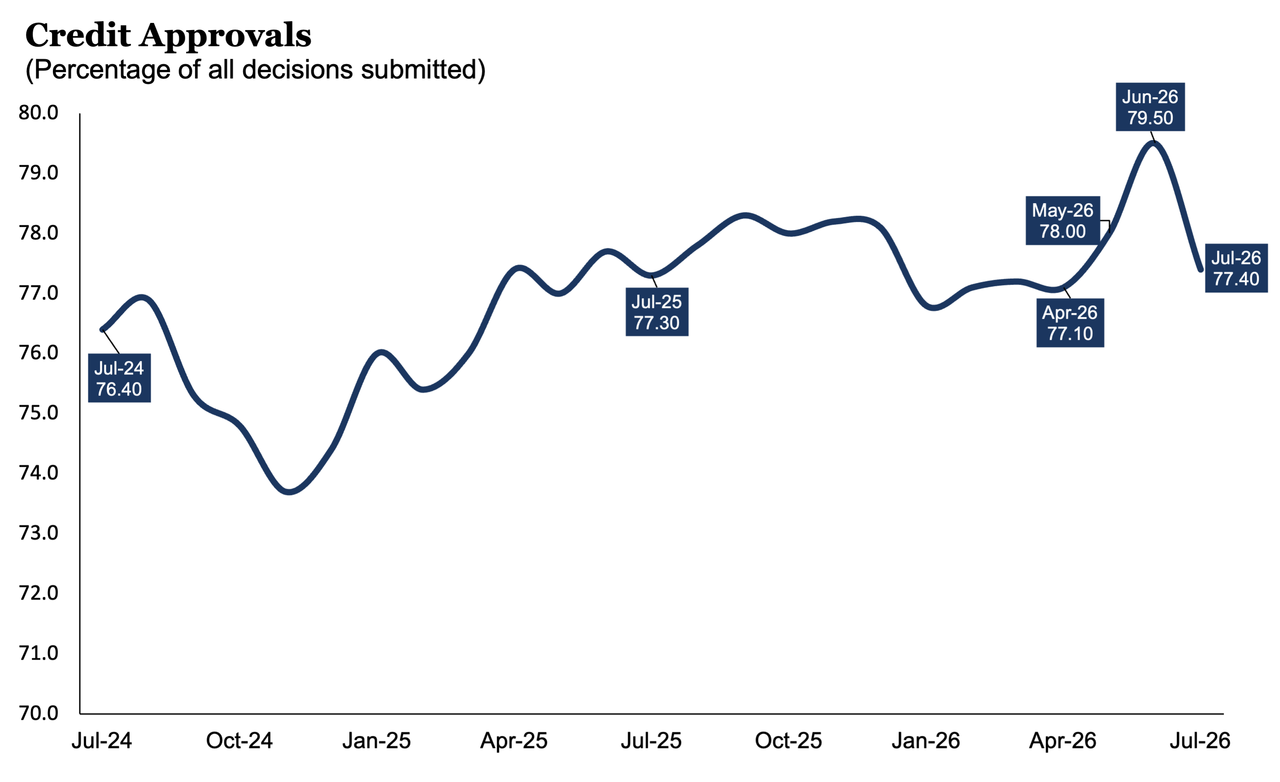
The drop in the credit approval rate was not broad-based
The industry-wide average eased 2.1 percentage points to 77.4% in July, more than reversing June’s gain. Nearly the entire decline stemmed from a small slice of the respondent pool. Approval rates across the rest of the panel were little changed, and the industry-wide average was flat year over year. The average small-ticket approval rate declined 1.0 percentage point to 79.7%. Banks accounted for most of the industry-wide drop, while captive approval rates rose 1.5 percentage points and the rate at independents fell 0.7 percentage points.
Delinquencies ticked up from a multi-year low, and losses fell
The overall delinquency rate rose to 1.8% in July after dropping to 1.7% in June. It remains at the lower end of its two-year range and is down roughly 0.2 percentage points year-over-year. Bank delinquency rates rose 0.29 percentage points and independents rose 0.17 percentage points, while captives edged down.
The overall loss rate decreased by 0.08 percentage points to 0.46%, its lowest level in nine months. The average loss rate at banks fell to 0.30%, the lowest reading since January 2023. The rate at independents dropped sharply, more than reversing its June increase, while the rate at captives rose. The average loss rate for small ticket deals was little changed at 0.73%.
Industry Confidence
The Monthly Confidence Index tracks the sentiment of executives in the industry. The index eased from 63.7 to 62.4 in August. Every respondent in the survey expected capex demand to remain at current levels or improve.

Businesses continue to navigate a complex environment shaped by geopolitical uncertainty, elevated costs, and interest-rate and market volatility,” said Deborah Baker, VP, Head of Global Payment Solutions, HP Inc. and ELFA Board Chair. “These factors are influencing both the timing and structure of capital investments, but they have not eliminated the need to invest. Financing is an essential tool to enable companies to acquire the technology they need to achieve their business objectives. Over the next three to six months, I expect demand to remain resilient as customers continue to benefit from favorable tax policy associated with equipment investment.
Technical Note
New business volume data are concurrently seasonally adjusted each month to capture the latest seasonal patterns. Data in previous months and years may change due to updated seasonal factors.