

Record Demand Outruns a Sticky Inflation Problem
WHAT’S AHEAD FOR THE EQUIPMENT FINANCE INDUSTRY:
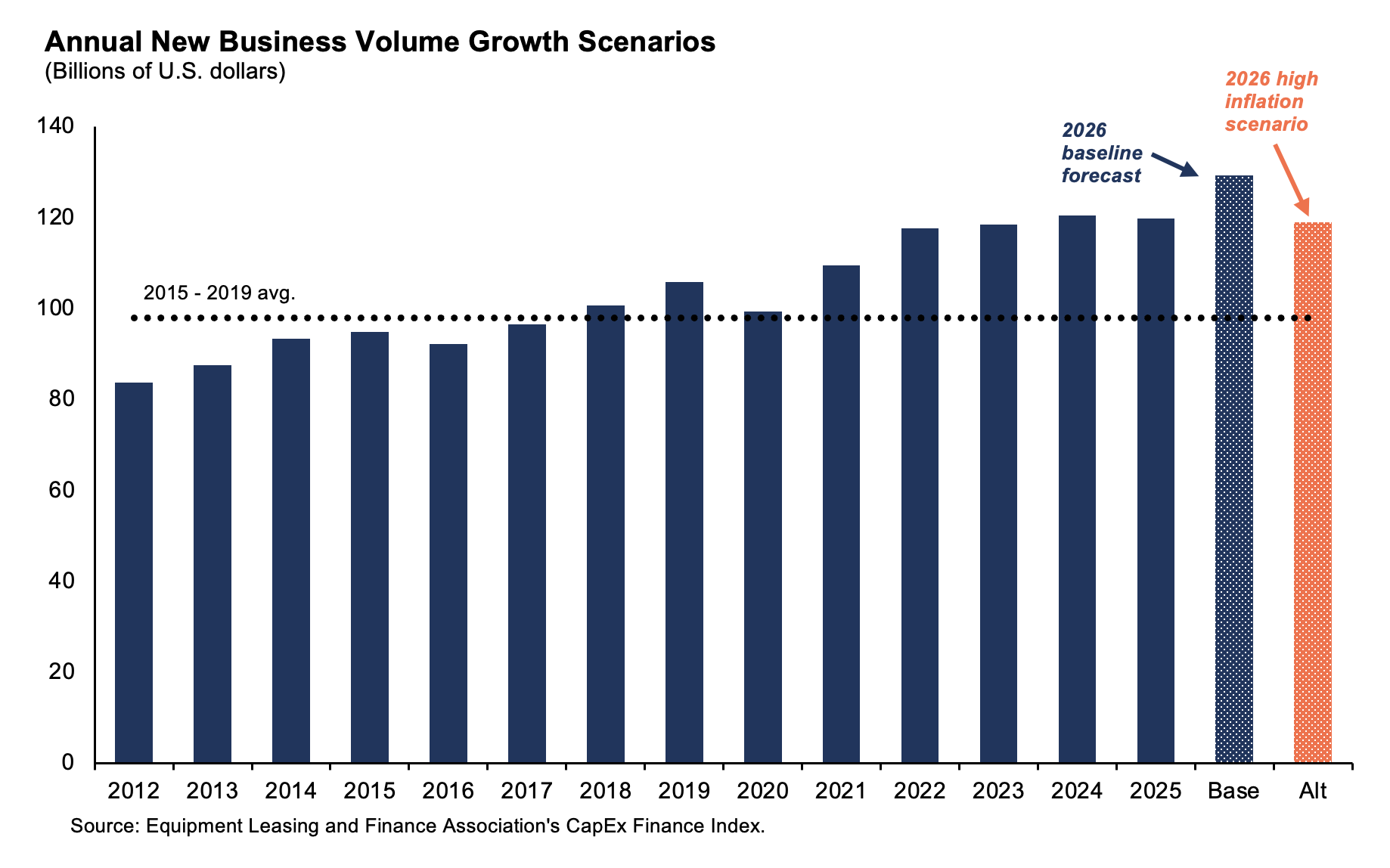
- Equipment demand is on pace to set a new record. Equipment investment topped 15% at an annual rate in both Q1 and Q2. New business volume among surveyed ELFA member companies should top $129 billion in 2026, the strongest reading in the history of the CapEx Finance Index (CFI). Even in our “high inflation” scenario, volumes remain near 2025 levels.
- The Fed's next move is more likely to be a hike than a cut. Some models indicate that the federal funds rate has fallen below its neutral level, signaling that Fed policy may no longer be restrictive. Policymakers are getting antsy with inflation above target for 63 straight months. Three regional presidents dissented in favor of a hike in July, the first triple dissent since 2016. Anyone building 2027 plans around a lower cost of funds should reconsider.
- Expect higher long-duration yields for the foreseeable future. The term premium in the ten-year Treasury has climbed out of the range it held for most of the last decade, and the increase looks durable. Our baseline puts the ten-year near 4.5% through early 2027, and our “high inflation” scenario above 5%. Even if the Fed cuts in 2027, less of that easing will reach market rates.
- A quieter Fed means more volatility in funding costs. Chair Warsh is saying considerably less about the outlook than his predecessors did. The rate path will increasingly be inferred from data releases rather than signaled in advance. Expect sharper moves in funding costs around data, and less lead time to reprice.
- Credit quality is sound but keep an eye on the loss rate. The delinquency rate in the equipment finance industry remains low. And while the average loss rate has picked up, according to the CFI, it is still at a level consistent with growing activity and minimal financial stress. In a year when volumes are setting records, the loss rate should be tracked to spot potential turning points.

ELFA Q3 Economic Outlook: Record Demand Outruns a Sticky Inflation Problem
ECONOMIC OUTLOOK:
The economy is bucking the volatility, and that is remarkable. The economy is expected to remain resilient, growing moderately over the second half of 2026. First-half growth looked soft on the surface. Elevated capital goods imports subtracted roughly 1.5 percentage points from growth over the first half, holding back the official number. That is not weakness. The import surge was led by capital goods, a sign of economic strength. And gains in equipment investment were widespread. Growth is expected to slow toward 1.7% through the first quarter of 2027, despite tariffs, an energy shock, and core inflation above 3%. That is what resilience looks like.
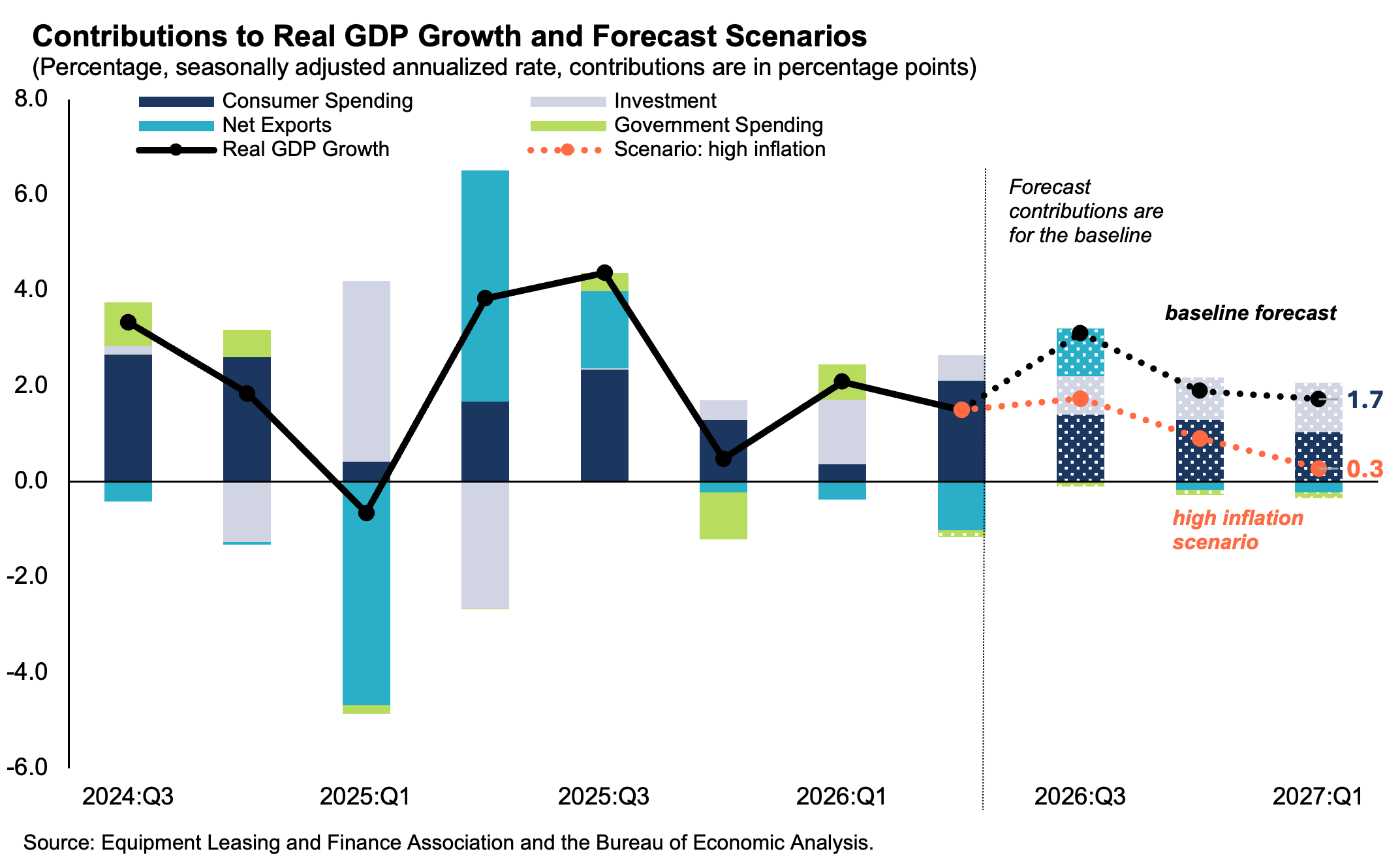
The consumer keeps spending, but the buffer is gone. Households have absorbed higher energy prices and years of above-target inflation, and it has come at a cost. The personal saving rate fell to 2.7% in June, a level it rarely approached during the 2010s expansion. That raises real questions about the sustainability of household spending, the clearest downside risk in our baseline.
The economy may not need to add jobs to stay healthy. The dwindling supply of labor remains one of the key economic developments of the last half-decade. Restrictive immigration policy and an aging population continue to push down both participation and employment growth. The economy can now shed jobs in a given month without a material change in the unemployment rate, making it difficult to assess labor market health and raising the risk of a Fed policy mistake in either direction.
Financing demand is broad-based, but this is mid-cycle. Core capital goods shipments are growing at more than 9% year over year, the fastest pace since 2022, and much of that will need to be financed. Shipments lag, but they offer the cleanest look at upstream financing demand because they track the arrival of actual equipment rather than orders that can be canceled. Confidence has also turned back up. The ELFA Monthly Confidence Index is up double digits since January 2024, though it remains modestly below where it started this year. History suggests the industry is mid-cycle rather than early, since previous stretches of double-digit growth have been followed by sharp declines. The AI surge may break that pattern. Either way, the question is about 2027, not 2026.
 Inflation may be stalling out. The much-anticipated spring energy price surge has so far been more of a fizzle. Core PCE ran at 3.3% over the 12 months ending in June, hot but not scorching, and that yearly figure includes data from some really hot months earlier this year. The monthly and quarterly data point to better news. Core PCE rose 3.4% at an annual rate in the second quarter, down from 4.4% in the first, and should hold in the low 3s for the rest of 2026, still well above the Fed's target, but not by enough to guarantee a rate hike.
AI-related inflation is not what it seems. The core PCE categories most exposed to AI-related demand added only about three basis points to the monthly core rate in June. Had AI-related inflation been zero over the past year, core PCE would have been only marginally lower. Our analysis excludes power prices because the energy shock from the Iran War would otherwise be misattributed to AI demand. The data center buildout is a real risk to power and gas prices in the years ahead, so this could get more troubling down the road.
Monetary policy may already be easy. Improving fundamentals are lifting potential growth and the equilibrium real rate, and inflation compensation in markets is rising as well. Together, those may have already pushed the neutral nominal rate above the actual federal funds rate. This creates two issues for the Fed. First, policy may be too easy, no matter what is happening with inflation. Second, inflation is above target. Those are two reasons for raising rates, and only one is about the recent inflation data.
What this means for the second half. Warsh's five task forces are expected to report by year-end, and the balance sheet review takes center stage for equipment finance. Runoff ended in December 2025, and a recommendation to resume reduction would push long-end yields higher even if short rates fall, compressing spreads and raising the cost of term ABS funding. Demand is strong, delinquencies remain low, and the pickup in the average loss rate is still consistent with growing activity. The risks this year are not on the demand side. They are on the cost of funds.


